
ECB officials agree: Eurozone is still saved from second-round inflation effects
- Euro slides to near 1.1178 against the US Dollar as the latter outperforms.
- Widening difference in spreads offered on bonds from France vs the rest of the Eurozone is hurting the Euro.
- ECB policymakers still do not see inflation effects passing into wages and prices.
The Euro (EUR) is down 0.16% to near 1.1178 against the US Dollar (USD) during the European trading session on Thursday. The major currency pair faces selling pressure as the US Dollar outperforms due to surging United States (US) bond yields.
US Dollar Price Today
The table below shows the percentage change of US Dollar (USD) against listed major currencies today. US Dollar was the strongest against the Australian Dollar.
| USD | EUR | GBP | JPY | CAD | AUD | NZD | CHF | |
|---|---|---|---|---|---|---|---|---|
| USD | 0.16% | 0.14% | 0.13% | 0.13% | 0.42% | 0.29% | 0.04% | |
| EUR | -0.16% | -0.02% | -0.02% | -0.04% | 0.19% | 0.13% | -0.12% | |
| GBP | -0.14% | 0.02% | 0.00% | -0.02% | 0.20% | 0.15% | -0.09% | |
| JPY | -0.13% | 0.02% | 0.00% | -0.01% | 0.22% | 0.12% | -0.08% | |
| CAD | -0.13% | 0.04% | 0.02% | 0.00% | 0.23% | 0.15% | -0.07% | |
| AUD | -0.42% | -0.19% | -0.20% | -0.22% | -0.23% | -0.05% | -0.30% | |
| NZD | -0.29% | -0.13% | -0.15% | -0.12% | -0.15% | 0.05% | -0.19% | |
| CHF | -0.04% | 0.12% | 0.09% | 0.08% | 0.07% | 0.30% | 0.19% |
The heat map shows percentage changes of major currencies against each other. The base currency is picked from the left column, while the quote currency is picked from the top row. For example, if you pick the US Dollar from the left column and move along the horizontal line to the Japanese Yen, the percentage change displayed in the box will represent USD (base)/JPY (quote).
As of writing, the US Dollar Index (DXY), which gauges the Greenback’s value against six major currencies, trades around 0.2% higher, near 102.44. The DXY is within striking distance of its annual high at 102.53 posted earlier this week. 10-year US Treasury Yields are close to their two-decade high of 5.36%.
Meanwhile, the Euro continues to face intense selling pressure amid heightened French fiscal worries. 10-year French bond yields are up over 2% to near 4.96%. The widening difference in yields offered by France vs the rest of the Eurozone is building significant pressure on the major currency.
On the monetary policy front, European Central Bank (ECB) officials continue to warn of upside risks, but still don’t see second-round inflation effects, a scenario in which initial price shock spreads into wages, services, and broader consumer prices.
Earlier in the day, ECB Governing Council member Emmanuel Moulin said that inflationary pressures are completely driven by energy shocks, but rules out fears of second-round inflation effects. “Inflation is clearly 100% energy, don't see second round effects,” Moulin said.
On Tuesday, ECB official and Governor of the Bank of Portugal Santos Pereira also pushed back second-round inflation fears. “There are no second-round inflation effects at present,” Pereira said.
Last week, ECB Governing Council member José Luis Escrivá also confirmed that inflation effects have not started spreading into wages or prices; however, he kept the possibility alive, saying, “In current situation high energy prices are worrisome if this persists and has second round effects."
EUR/USD Technical Analysis
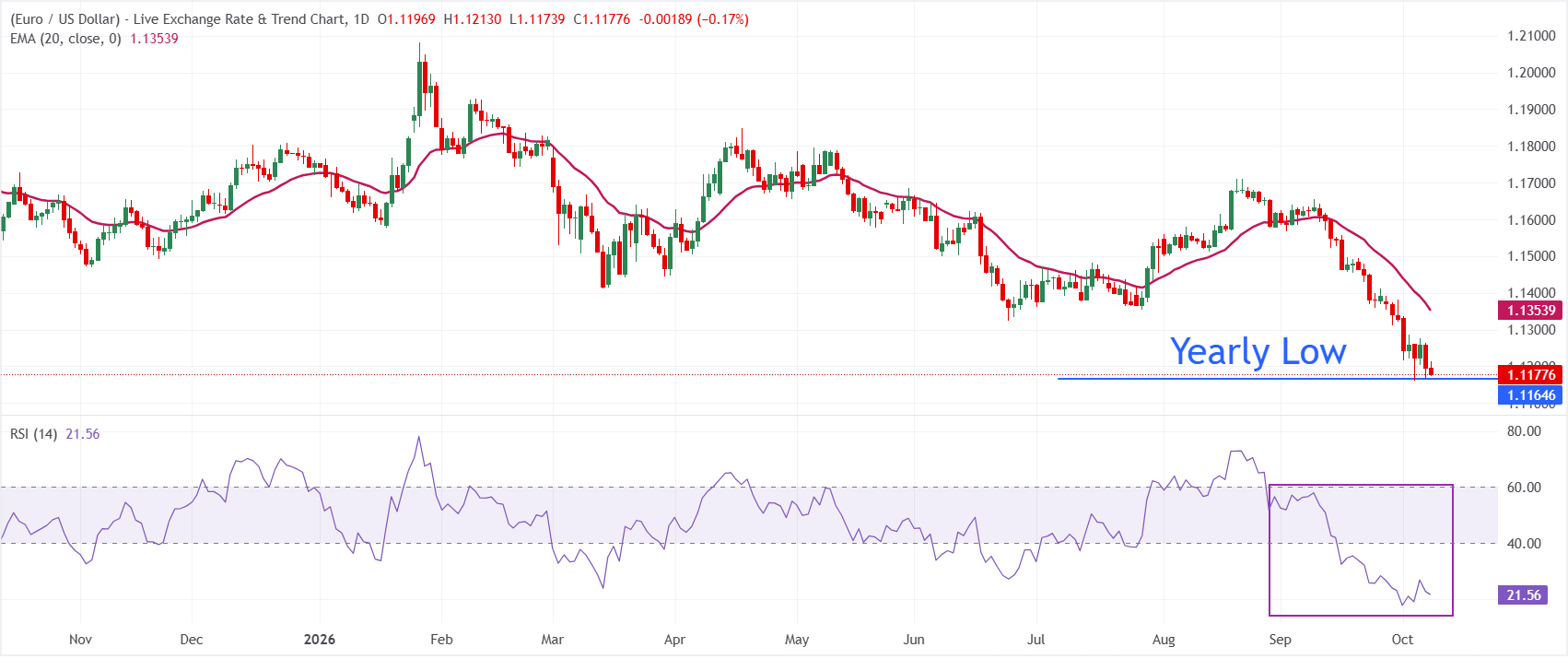
On the daily chart, EUR/USD trades at 1.1178, maintaining a bearish near-term bias as spot holds well below the 20-period Exponential Moving Average (EMA) at 1.1354. The pair continues to slide away from the recent cluster of prices around the mid-1.15s, while the 14-period Relative Strength Index (RSI) at 21.6 sits in oversold territory, suggesting persistent selling pressure despite the increasingly stretched downside.
On the topside, immediate resistance is located at the 20-period EMA at 1.1354, which caps any recovery attempts and defines the first hurdle for a more meaningful rebound. With no nearby technical support derived from the current dataset, traders may look to price action around the 1.1178 area for signs of stabilization, while any bounce would likely struggle as long as EUR/USD remains below the 1.1354 barrier.
(The technical analysis of this story was written with the help of an AI tool. Know more.)
Euro FAQs
The Euro is the currency for the 20 European Union countries that belong to the Eurozone. It is the second most heavily traded currency in the world behind the US Dollar. In 2022, it accounted for 31% of all foreign exchange transactions, with an average daily turnover of over $2.2 trillion a day. EUR/USD is the most heavily traded currency pair in the world, accounting for an estimated 30% off all transactions, followed by EUR/JPY (4%), EUR/GBP (3%) and EUR/AUD (2%).
The European Central Bank (ECB) in Frankfurt, Germany, is the reserve bank for the Eurozone. The ECB sets interest rates and manages monetary policy. The ECB’s primary mandate is to maintain price stability, which means either controlling inflation or stimulating growth. Its primary tool is the raising or lowering of interest rates. Relatively high interest rates – or the expectation of higher rates – will usually benefit the Euro and vice versa. The ECB Governing Council makes monetary policy decisions at meetings held eight times a year. Decisions are made by heads of the Eurozone national banks and six permanent members, including the President of the ECB, Christine Lagarde.
Eurozone inflation data, measured by the Harmonized Index of Consumer Prices (HICP), is an important econometric for the Euro. If inflation rises more than expected, especially if above the ECB’s 2% target, it obliges the ECB to raise interest rates to bring it back under control. Relatively high interest rates compared to its counterparts will usually benefit the Euro, as it makes the region more attractive as a place for global investors to park their money.
Data releases gauge the health of the economy and can impact on the Euro. Indicators such as GDP, Manufacturing and Services PMIs, employment, and consumer sentiment surveys can all influence the direction of the single currency. A strong economy is good for the Euro. Not only does it attract more foreign investment but it may encourage the ECB to put up interest rates, which will directly strengthen the Euro. Otherwise, if economic data is weak, the Euro is likely to fall. Economic data for the four largest economies in the euro area (Germany, France, Italy and Spain) are especially significant, as they account for 75% of the Eurozone’s economy.
Another significant data release for the Euro is the Trade Balance. This indicator measures the difference between what a country earns from its exports and what it spends on imports over a given period. If a country produces highly sought after exports then its currency will gain in value purely from the extra demand created from foreign buyers seeking to purchase these goods. Therefore, a positive net Trade Balance strengthens a currency and vice versa for a negative balance.