
ADP Employment Report expected to confirm a tight labour market in September
- The US ADP Employment Change report is forecast to show a 72K increase in net employment in September.
- If the market consensus is confirmed, it will endorse the theory of US economic exceptionalism.
- The impact on the US Dollar is likely to depend on the outcome of the PCE Price Index due at the same time.
The Automatic Data Processing (ADP) Research Institute will release September’s monthly report on private-sector employment creation on Wednesday. The ADP Employment Change report is forecast to reveal that net employment in the United States (US) private sector increased by 72K this month, almost twice the 38K new jobs reported in August.
ADP data is closely watched by markets as it sets the sentiment ahead of the all-important Nonfarm Payrolls (NFP) report, usually released a couple of days later by the US Bureau of Labor Statistics. This time, however, the ADP report will have to share the spotlight with the key US Personal Consumption Expenditures (PCE) Price Index data, the Federal Reserve’s (Fed) gauge of choice for assessing inflationary trends, which will be released 15 minutes later and might end up stealing the show.
ADP jobs report is expected to reflect a resilient labour market
Markets hold an optimistic view of US employment trends, especially after the outstanding August Nonfarm Payrolls report, which showed a 162K net increase in job creation and a steady Unemployment Rate at 4.1%, its lowest level in more than a year.
Apart from that, more recent data has contributed to keeping spirits high, as analysts at OCBC note: “Recent claims data have continued to trend lower, suggesting labour market conditions remain firm.” Weekly ADP data has also been positive, as the latest reports showed that US private employers added an average of 20K jobs per week, up to the first week of this month.
Against this background, investors are expecting September’s labor data to confirm that the market remains tight, which, together with the strong inflationary pressures stemming from high energy prices, will pave the path for the Fed to tighten its monetary policy further in October or December at the latest. Futures markets are pricing in a 70% chance of a quarter-point interest rate hike in October and 60% odds that the US central bank will hike rates by 50 basis points before year-end, according to the data released by the CME Group’s FedWatch Tool.
It is worth recalling, however, that markets will contrast the ADP outcome with the PCE Price Index report released almost simultaneously for a more complete picture of the Fed’s monetary policy outlook. PCE inflation is widely expected to reflect upside pressures from high Oil prices, amid uncertainty in the Middle East, and show that consumer prices remain well above the Fed’s target. In that sense, employment data is seen as the sidekick to underpin the central bank’s hawkish stance this week.
Federal Reserve officials have reiterated that inflation pressures remain too high and that the bank might have to hike interest rates again. Fed Governor Lisa Cook went further on Monday, stating that the “number and magnitude of any future rate adjustments will be informed by inflation and labor market data,” thus increasing interest in this week’s releases.
When will the ADP report be released, and how could it affect the USD?
The US ADP Employment Change report will be out on Wednesday at 12:15 GMT, and it is expected to show that the private sector created 72K new jobs in September. If the final data meets expectations and is followed by hot PCE Price Index figures, it will boost hopes of another Fed interest rate hike in October and provide additional support to the US Dollar (USD).
Forex experts at Societe Generale anticipate that the combination of "higher inflation and resilient real-economy data could propel the Dollar Index to a near-2026 high (just 0.7% away) or push EUR/USD to a new low (only 0.5% away)," underscoring the potential for renewed Greenback strength even as investors digest the upcoming economic data releases.
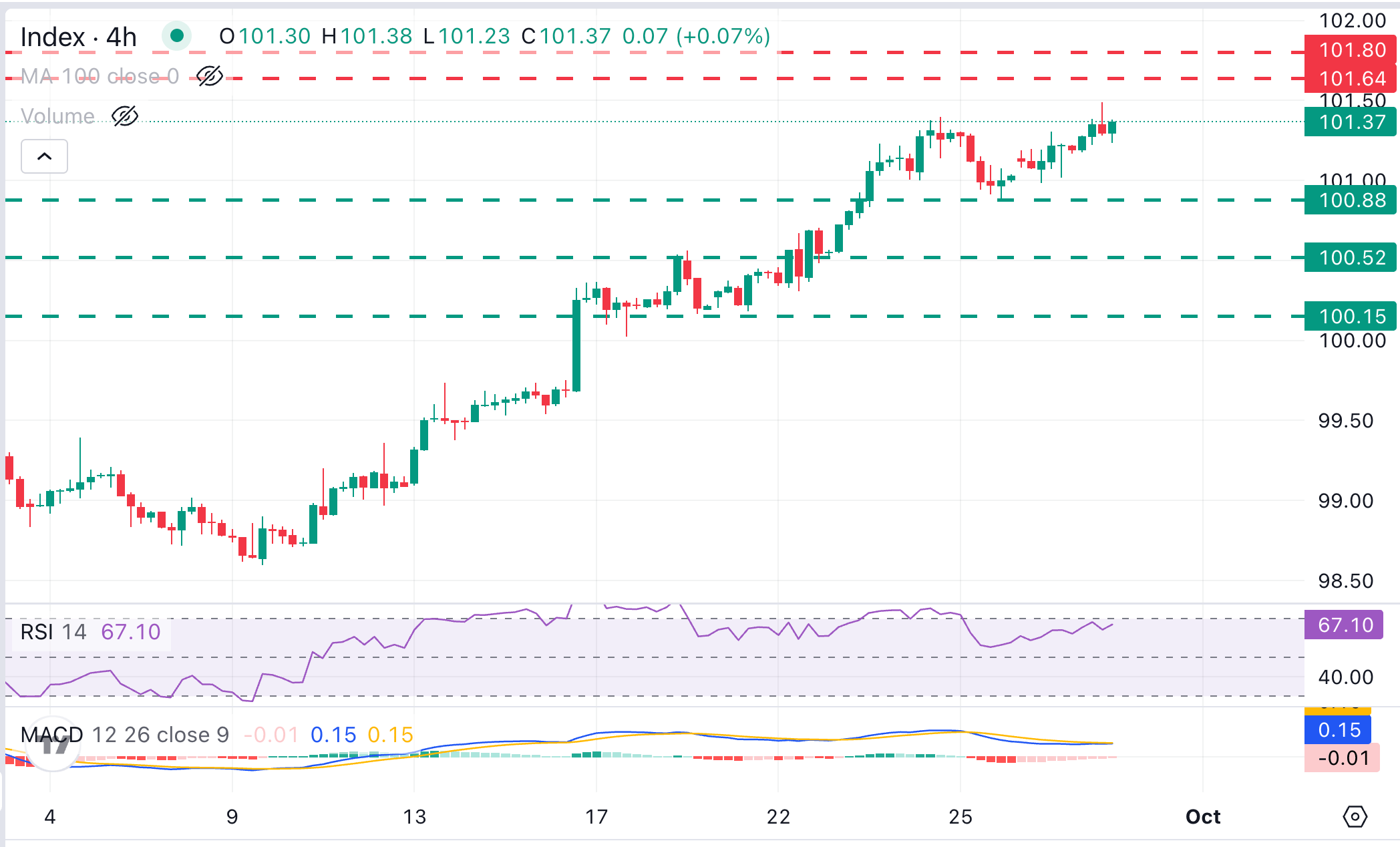
The US Dollar Index (DXY) technical picture shows a solid bullish trend, after rallying nearly 2.5% in less than three weeks, which has boosted price action to two-month highs near 101.50 at the time of writing. Fundamentals are supportive, but the Relative Strength Index (RSI) is reaching overbought levels on intraday charts, suggesting that the trend may be overextended and warning about a potential bearish correction.
According to Guillermo Alcalá, Analyst at FXStreet.com, bulls are likely to meet resistance at the 2026 highs of 101.64 and 101.80, July and June’s peaks, respectively. If these levels give way, the next target is the May 2025 high near 102.00. Bearish attempts, on the other hand, are likely to be tested at the ascending trendline support, now at 101.25 ahead of the September 25 low near 100.90. ”Further decline is likely to require a significant disappointment in US macroeconomic figures,” says Alcalá.
Inflation FAQs
Inflation measures the rise in the price of a representative basket of goods and services. Headline inflation is usually expressed as a percentage change on a month-on-month (MoM) and year-on-year (YoY) basis. Core inflation excludes more volatile elements such as food and fuel which can fluctuate because of geopolitical and seasonal factors. Core inflation is the figure economists focus on and is the level targeted by central banks, which are mandated to keep inflation at a manageable level, usually around 2%.
The Consumer Price Index (CPI) measures the change in prices of a basket of goods and services over a period of time. It is usually expressed as a percentage change on a month-on-month (MoM) and year-on-year (YoY) basis. Core CPI is the figure targeted by central banks as it excludes volatile food and fuel inputs. When Core CPI rises above 2% it usually results in higher interest rates and vice versa when it falls below 2%. Since higher interest rates are positive for a currency, higher inflation usually results in a stronger currency. The opposite is true when inflation falls.
Although it may seem counter-intuitive, high inflation in a country pushes up the value of its currency and vice versa for lower inflation. This is because the central bank will normally raise interest rates to combat the higher inflation, which attract more global capital inflows from investors looking for a lucrative place to park their money.
Formerly, Gold was the asset investors turned to in times of high inflation because it preserved its value, and whilst investors will often still buy Gold for its safe-haven properties in times of extreme market turmoil, this is not the case most of the time. This is because when inflation is high, central banks will put up interest rates to combat it. Higher interest rates are negative for Gold because they increase the opportunity-cost of holding Gold vis-a-vis an interest-bearing asset or placing the money in a cash deposit account. On the flipside, lower inflation tends to be positive for Gold as it brings interest rates down, making the bright metal a more viable investment alternative.
Employment FAQs
Labor market conditions are a key element to assess the health of an economy and thus a key driver for currency valuation. High employment, or low unemployment, has positive implications for consumer spending and thus economic growth, boosting the value of the local currency. Moreover, a very tight labor market – a situation in which there is a shortage of workers to fill open positions – can also have implications on inflation levels and thus monetary policy as low labor supply and high demand leads to higher wages.
The pace at which salaries are growing in an economy is key for policymakers. High wage growth means that households have more money to spend, usually leading to price increases in consumer goods. In contrast to more volatile sources of inflation such as energy prices, wage growth is seen as a key component of underlying and persisting inflation as salary increases are unlikely to be undone. Central banks around the world pay close attention to wage growth data when deciding on monetary policy.
The weight that each central bank assigns to labor market conditions depends on its objectives. Some central banks explicitly have mandates related to the labor market beyond controlling inflation levels. The US Federal Reserve (Fed), for example, has the dual mandate of promoting maximum employment and stable prices. Meanwhile, the European Central Bank’s (ECB) sole mandate is to keep inflation under control. Still, and despite whatever mandates they have, labor market conditions are an important factor for policymakers given its significance as a gauge of the health of the economy and their direct relationship to inflation.