
Japanese Yen falls like house of cards as BoJ hike interest rates by 25 bps to 1.25%
- The Japanese Yen plummets against the US Dollar after the BoJ’s monetary policy announcement.
- The BoJ hikes rates by 25 bps to 1.25% and warns of inflation excessing the 2% target.
- Investors await BoJ Ueda’s press conference for fresh cues on the monetary policy outlook.
The Japanese Yen (JPY) plunges against the US Dollar (USD) after the Bank of Japan’s (BoJ) monetary policy decision. As of writing, the USD/JPY pair surges to near 156.95.
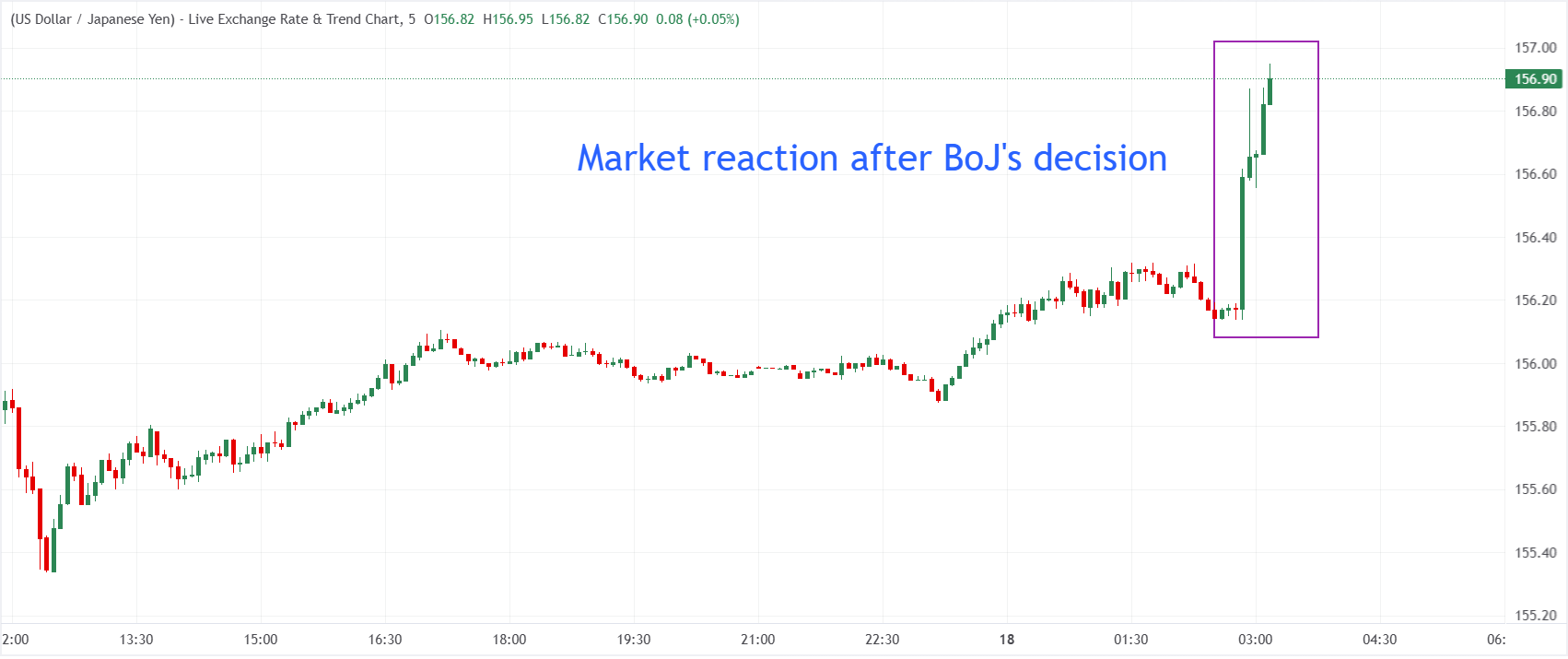
The BoJ has hiked interest rates by 25 basis points (bps) to 1.25%, the highest level seen in 31 years. The Japanese central bank was highly anticipated to tighten its monetary conditions, as market experts believed that latest wage data supports path to quicker policy normalization.
Analysts at Deutsche Bank said last week that the latest upside surprise in Japan’s wage data “reinforces the overwhelming case for the BoJ to raise interest rates at policy meeting on September 18, following its previous hike three months ago”.
In the monetary policy statement, the BoJ has warned of risk that “inflation might exceed the central bank’s 2% target”, adding, “Recent Yen depreciation likely to push prices higher.”
Meanwhile, investors await BoJ Governor Kazuo Ueda’s press conference to get fresh cues regarding whether the central bank will remain on the monetary tightening path, and if so, how much the pace of policy tightening will be.
Strategists at Danske Bank anticipates a shift in the communication around the policy path, saying “we expect BoJ will signal a nimbler approach to the tightening pace than the very cautious hiking cycle we have witnessed so far.”
On the US Dollar front, traders remain confident that the Federal Reserve (Fed) will deliver one more interest rate hike this year. The Fed hiked its key policy rates by 25 bps to the 3.75%-4.00% range on Wednesday and warned that inflation is too high for a long time.
USD/JPY Technical Analysis
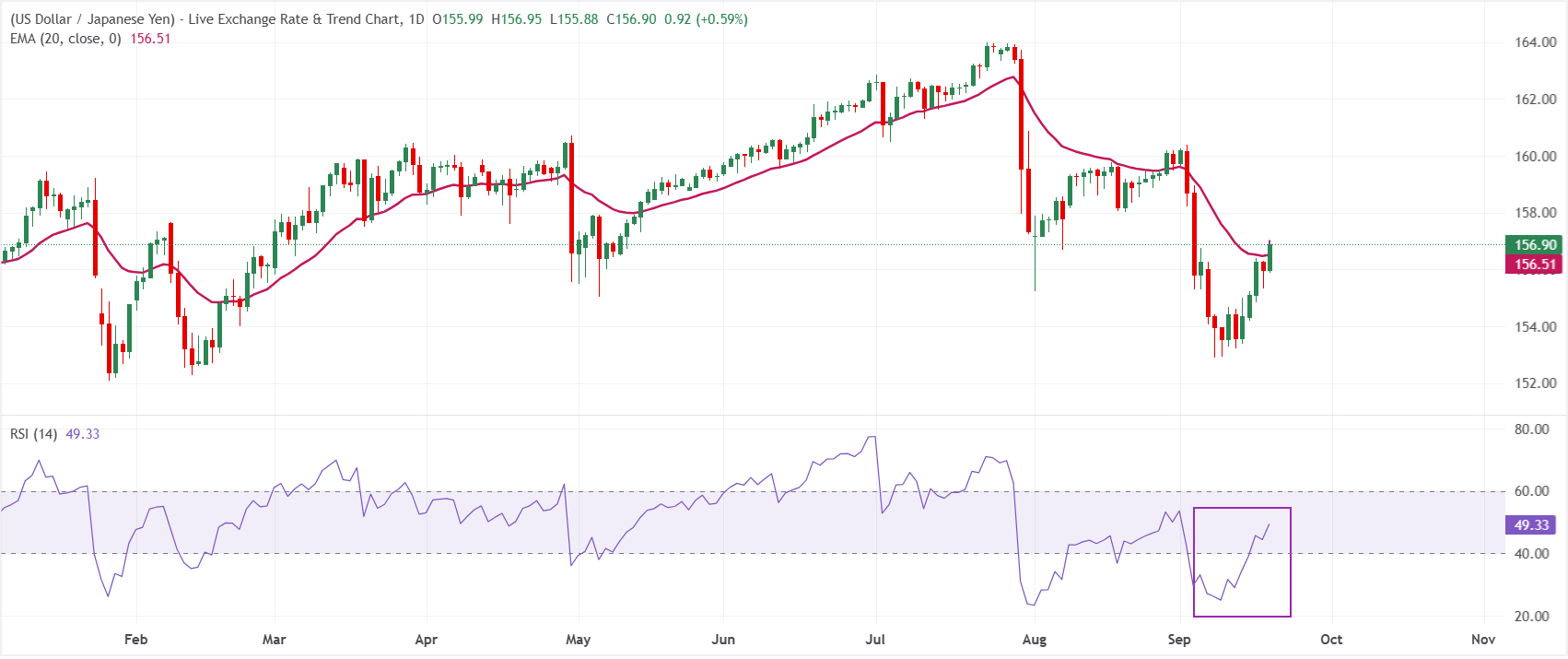
In the daily chart, USD/JPY trades at 156.88. The pair holds above the 20-period exponential moving average (EMA) at 156.51, keeping a mild bullish bias in place as price builds a floor over the short-term trend indicator. The Relative Strength Index (RSI) at 49.26 sits near the neutral line, hinting that upside pressure is constructive but not yet extended.
On the downside, initial support is seen at the 20-day EMA around 156.51, where a daily close below would weaken the current positive tone and expose deeper retracements. As long as USD/JPY defends this moving average, buyers are likely to retain control of the near-term structure, with any break higher from current levels poised to extend the broader advance despite the lack of clearly defined overhead resistance in the immediate data.
(The technical analysis of this story was written with the help of an AI tool. Know more.)
Bank of Japan FAQs
The Bank of Japan (BoJ) is the Japanese central bank, which sets monetary policy in the country. Its mandate is to issue banknotes and carry out currency and monetary control to ensure price stability, which means an inflation target of around 2%.
The Bank of Japan embarked in an ultra-loose monetary policy in 2013 in order to stimulate the economy and fuel inflation amid a low-inflationary environment. The bank’s policy is based on Quantitative and Qualitative Easing (QQE), or printing notes to buy assets such as government or corporate bonds to provide liquidity. In 2016, the bank doubled down on its strategy and further loosened policy by first introducing negative interest rates and then directly controlling the yield of its 10-year government bonds. In March 2024, the BoJ lifted interest rates, effectively retreating from the ultra-loose monetary policy stance.
The Bank’s massive stimulus caused the Yen to depreciate against its main currency peers. This process exacerbated in 2022 and 2023 due to an increasing policy divergence between the Bank of Japan and other main central banks, which opted to increase interest rates sharply to fight decades-high levels of inflation. The BoJ’s policy led to a widening differential with other currencies, dragging down the value of the Yen. This trend partly reversed in 2024, when the BoJ decided to abandon its ultra-loose policy stance.
A weaker Yen and the spike in global energy prices led to an increase in Japanese inflation, which exceeded the BoJ’s 2% target. The prospect of rising salaries in the country – a key element fuelling inflation – also contributed to the move.