
Japanese Yen flattens against US Dollar in countdown to Jackson Hole Symposium
- The Japanese Yen trades calmly against the US Dollar at around 159.30 ahead of the Jackson Hole Symposium.
- Fed Warsh’s remarks to have a significant impact on the US Dollar.
- The BoJ is highly anticipated to raise interest rates at the September meeting.
The Japanese Yen (JPY) trades in a limited range at around 159.30 against the US Dollar (USD) during the European trading session on Thursday. The USD/JPY pair consolidates as investors await Federal Reserve (Fed) Chairman Kevin Warsh’s speech at the Jackson Hole Symposium on Friday.
The comments from Fed Chair Warsh are expected to significantly influence central banks’ interest rate expectations, and are expected to be a key trigger for the US Dollar.
Dollar support seen hinging on Fed messaging at Jackson Hole
Strategists at OCBC note that “questions around the Fed's reaction function and concerns that policymakers may be placing less emphasis on inflation control” have sharpened market attention on Chair Warsh’s upcoming remarks at Jackson Hole. In their view, the USD could “find support if Warsh and other Fed officials push back against debasement concerns and reaffirm their commitment to returning inflation to the Fed's 2% target,” with the conference seen as a key venue for the Fed to clarify its stance on inflation and policy credibility.
At the time of writing, the US Dollar Index holds onto previous day’s gains at around 99.15. The USD Index gained sharply on Wednesday after the release of the United States (US) Personal Consumption Expenditure (PCE) Price Index report for July, which showed that price pressures remained sticky.
US yields climb as PCE surprise supports Dollar and keeps Fed hike risk alive
Strategists at UOB Group note that US Treasury yields firmed after the Fed’s preferred inflation gauge delivered “mixed signals” for July. They highlight that “headline PCE inflation came in slightly above expectations at 3.7% y/y (consensus: 3.6%), while core PCE matched forecasts at 3.3% y/y.” In their view, the inflation print helped the US Dollar, as “the US dollar strengthened against most G10 currencies as the inflation data kept alive expectations that the Federal Reserve may still resume rate hikes.”
On the Tokyo front, investors look beyond the Bank of Japan’s (BoJ) September policy meeting, where the central bank is highly anticipated to raise interest rates by 25 basis points (bps) to 1.25%.
Strategists at Scotiabank note that while markets have begun to reprice the near-term policy path, the “greater risk will center around the central bank’s tone as market participants look beyond the September 18 meeting,” suggesting investors are increasingly focused on how the BoJ will frame its outlook rather than the decision itself.
According to the August 17-24 survey in a Reuters poll, 57% of economists expected the BoJ to raise its interest rate in September, a sharp turnaround from a July poll, when just 5% expected an interest rate hike.
USD/JPY Technical Analysis
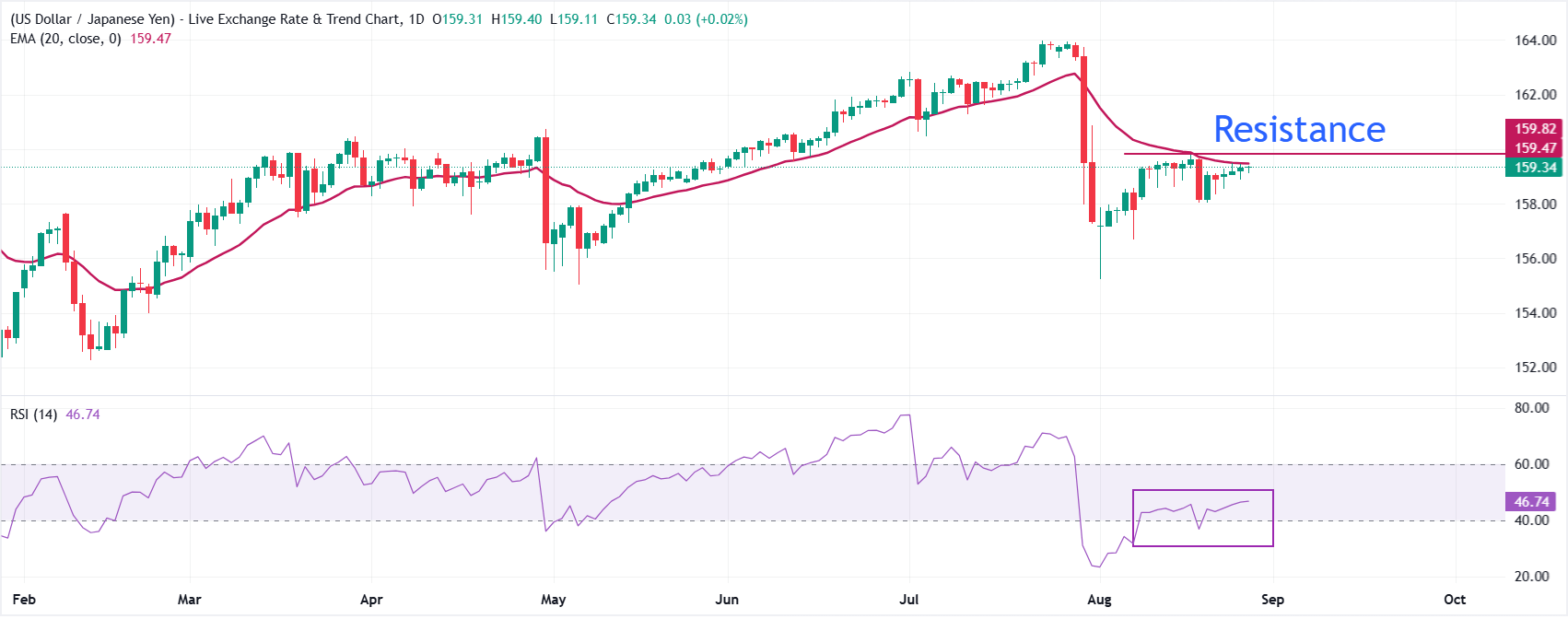
In the daily chart, USD/JPY trades at 159.34, keeping a bearish near-term tone as spot remains capped by the 20-day exponential moving average (EMA) at 159.47. The pair is holding just under this dynamic resistance after its recent pullback, while the Relative Strength Index (RSI) at 46.7 has stabilized below the 50 line, hinting at fading downside momentum but not yet signaling a bullish recovery.
On the topside, immediate resistance is located at the 20-day EMA around 159.47, and a sustained break above this hurdle would be needed to ease the current pressure and allow a retest of recent highs. On the downside, the lack of nearby mapped support levels leaves the pair vulnerable to further slippage, with traders likely watching prior swing lows as the next potential demand area if selling resumes.
(The technical analysis of this story was written with the help of an AI tool. Know more.)
US Dollar FAQs
The US Dollar (USD) is the official currency of the United States of America, and the ‘de facto’ currency of a significant number of other countries where it is found in circulation alongside local notes. It is the most heavily traded currency in the world, accounting for over 88% of all global foreign exchange turnover, or an average of $6.6 trillion in transactions per day, according to data from 2022. Following the second world war, the USD took over from the British Pound as the world’s reserve currency. For most of its history, the US Dollar was backed by Gold, until the Bretton Woods Agreement in 1971 when the Gold Standard went away.
The most important single factor impacting on the value of the US Dollar is monetary policy, which is shaped by the Federal Reserve (Fed). The Fed has two mandates: to achieve price stability (control inflation) and foster full employment. Its primary tool to achieve these two goals is by adjusting interest rates. When prices are rising too quickly and inflation is above the Fed’s 2% target, the Fed will raise rates, which helps the USD value. When inflation falls below 2% or the Unemployment Rate is too high, the Fed may lower interest rates, which weighs on the Greenback.
In extreme situations, the Federal Reserve can also print more Dollars and enact quantitative easing (QE). QE is the process by which the Fed substantially increases the flow of credit in a stuck financial system. It is a non-standard policy measure used when credit has dried up because banks will not lend to each other (out of the fear of counterparty default). It is a last resort when simply lowering interest rates is unlikely to achieve the necessary result. It was the Fed’s weapon of choice to combat the credit crunch that occurred during the Great Financial Crisis in 2008. It involves the Fed printing more Dollars and using them to buy US government bonds predominantly from financial institutions. QE usually leads to a weaker US Dollar.
Quantitative tightening (QT) is the reverse process whereby the Federal Reserve stops buying bonds from financial institutions and does not reinvest the principal from the bonds it holds maturing in new purchases. It is usually positive for the US Dollar.